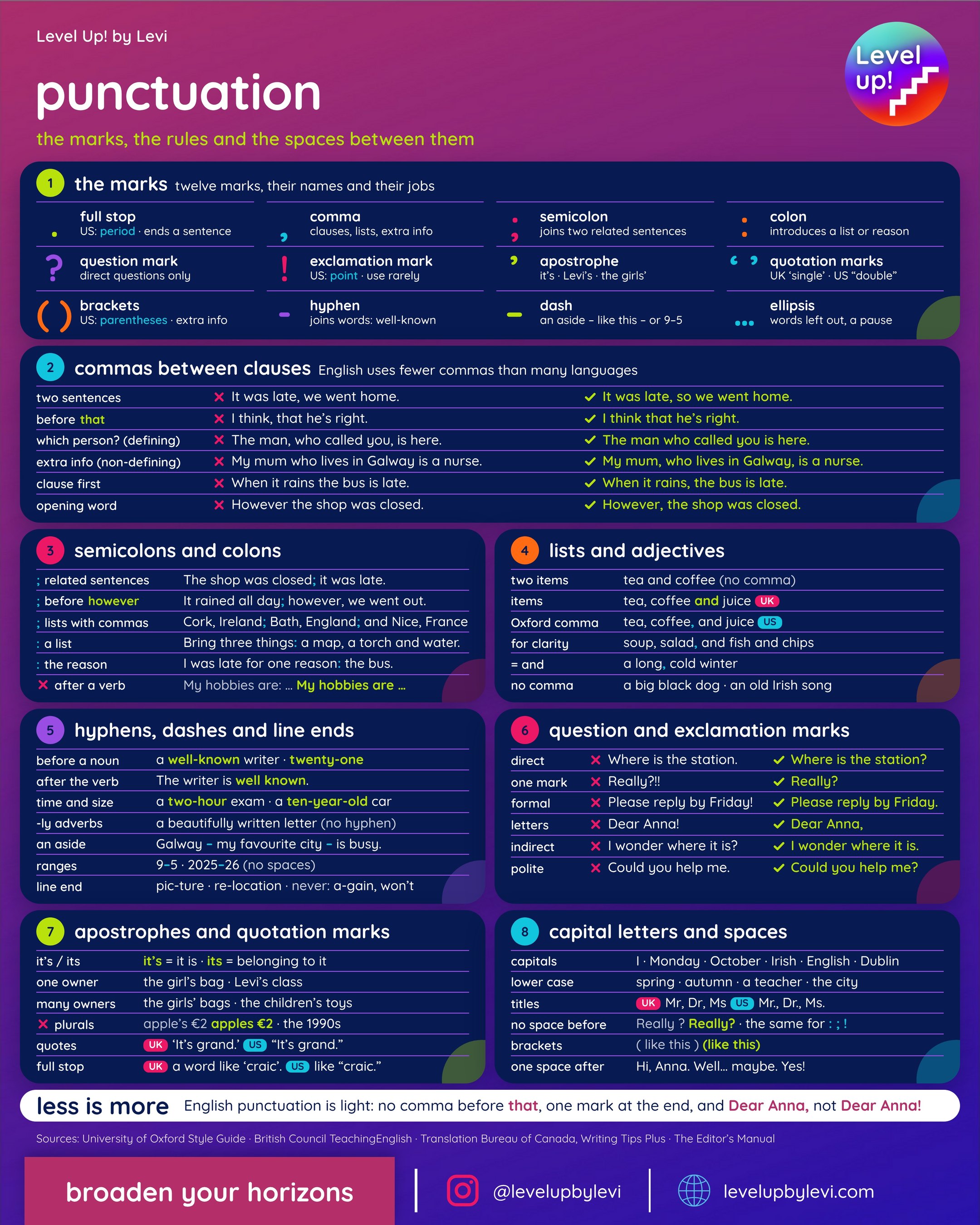
English punctuation is lighter than in many languages: fewer commas, one mark at the end of a sentence, and an exclamation mark only when you really mean it.
The twelve marks
Their British names, with the American name where it is different:
. full stop (US: period) · , comma · ; semicolon · : colon
? question mark · ! exclamation mark (US: exclamation point) · ’ apostrophe
‘ ’ quotation marks · ( ) brackets (US: parentheses) · - hyphen · – dash · … ellipsis
Commas between clauses
Never join two full sentences with a comma alone, and don’t put a comma before that. Extra information takes two commas; information that tells you which one takes none.
It was late, so we went home. (not It was late, we went home.)
I think that he’s right. (not I think, that he’s right.)
My mum, who lives in Galway, is a nurse.
The man who called you is here.
When it rains, the bus is late.
Semicolons and colons
A semicolon joins two related sentences. A colon introduces a list, a reason or an explanation, but never straight after a verb.
The shop was closed; it was late.
It rained all day; however, we went out.
Bring three things: a map, a torch and water.
My hobbies are hiking and reading. (not My hobbies are: …)
Lists, hyphens and dashes
British English usually has no comma before and in a list; American English often does (the Oxford comma). A hyphen joins words; a dash separates.
tea, coffee and juice · tea, coffee, and juice (US)
a well-known writer · The writer is well known.
Galway – my favourite city – is busy. · open 9–5
Apostrophes and quotation marks
Never use an apostrophe to make a plural. British and Irish English use single quotation marks; American English uses double.
it’s = it is · its = belonging to it
the girl’s bag · the girls’ bags · the children’s toys
apples €2 · the 1990s
She said, ‘It’s grand.’ (US: “It’s grand.”)
Questions, capitals and spaces
One mark at the end of a sentence. Capitals for days, months, nationalities and languages. No space before ? ! : ;
I wonder where the station is. · Could you help me?
Dear Anna, (not Dear Anna!)
on Monday in October · Irish · English · but: autumn
Really? (not Really ?)