
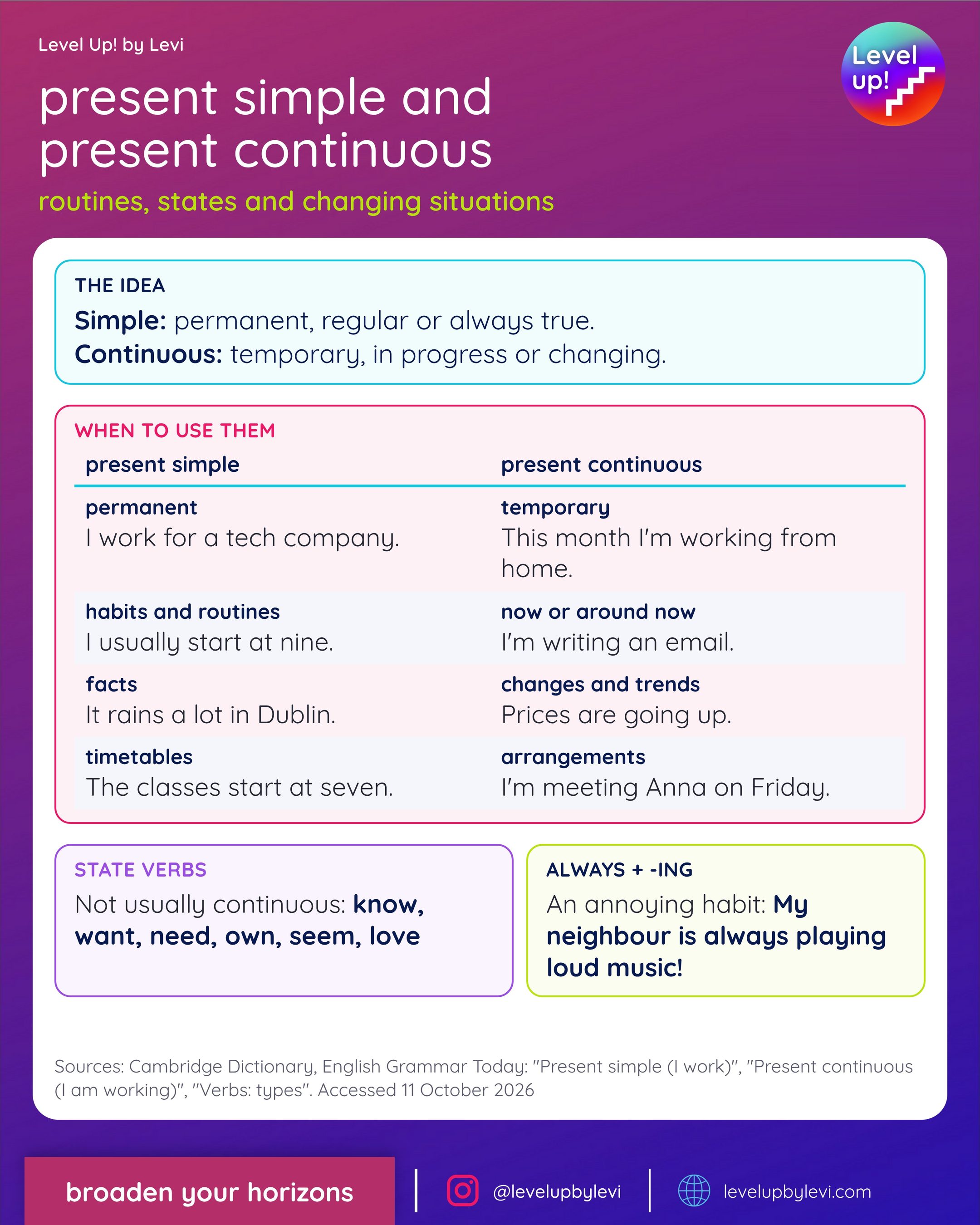
Use the present simple for things that are permanent, regular or always true. Use the present continuous for things that are temporary, in progress or changing.
Form
Present simple
verb / verb + -s
Add -s or -es with he, she and it. Use do / does in negatives and questions.
Positive: She works from home.
Negative: She doesn’t work on Fridays.
Question: Does she work at weekends?
Present continuous
am / is / are + verb-ing
Use am, is or are + the -ing form of the verb.
Positive: She’s working from home this week.
Negative: She isn’t working today.
Question: Is she working on a new project?
When to use them
Compare each pair. The first sentence describes the general picture; the second describes something temporary, happening now or planned.
I work for a tech company.
This month I’m working from home.
I usually start at nine.
I’m writing an email.
It rains a lot in Dublin.
Prices are going up.
The classes start at seven.
I’m meeting Anna on Friday.
Words such as always, usually, every day and on Mondays often go with the present simple. Now, at the moment, this week and these days often go with the present continuous.
State verbs
Some verbs describe states, not actions, so they are not usually used in the continuous form: know, want, need, own, seem, love, believe, understand.
I know the answer. (not I’m knowing)
We need more time. (not We’re needing)
A few verbs have one meaning as a state and another as an action:
I think it’s a good idea. → I’m thinking about a new job.
We have a car. → We’re having dinner.