
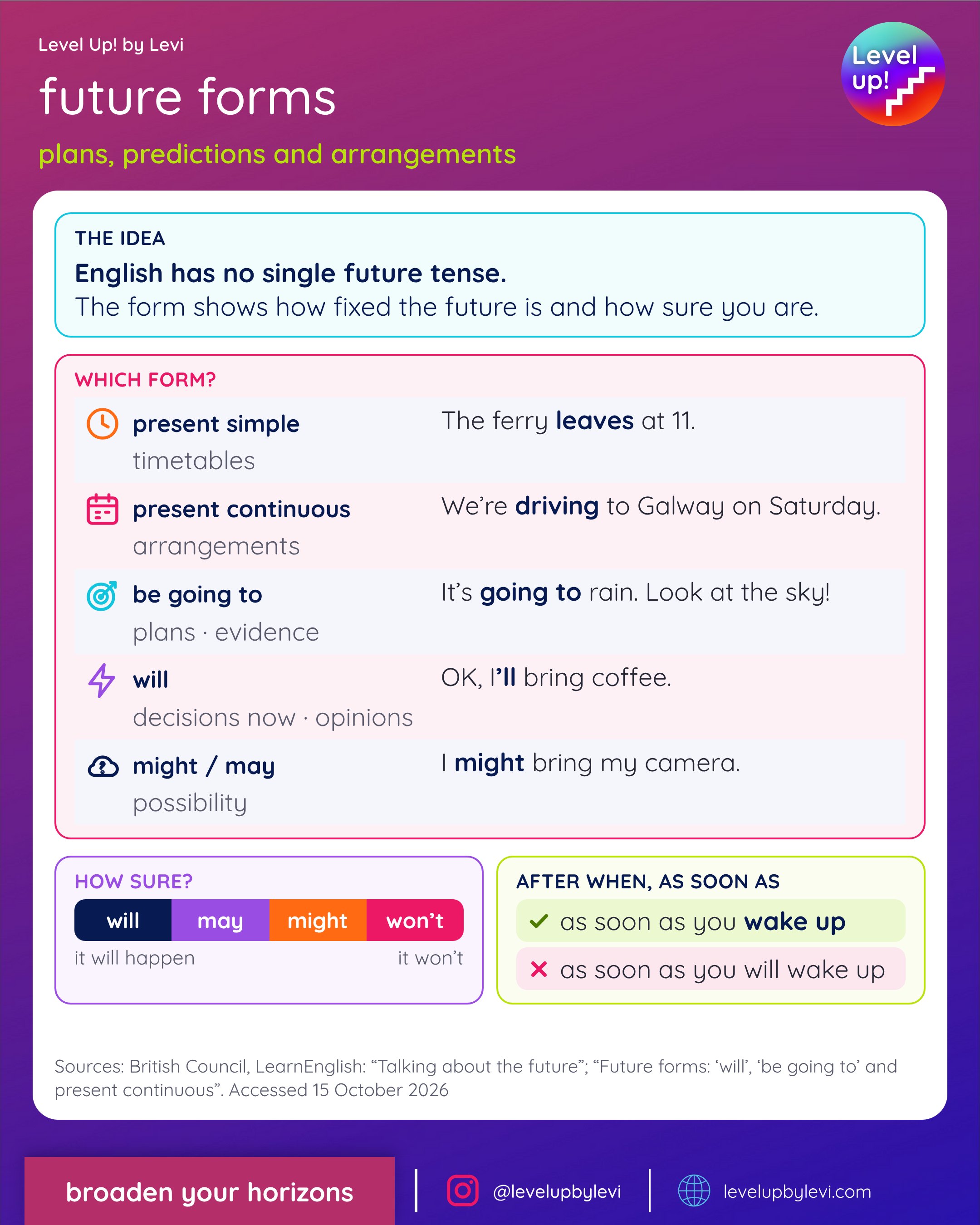
English has no single future tense. The form you choose shows how fixed the future is and how sure you are.
Five ways to talk about the future
Present simple
verb / verb + -s
For timetables and schedules.
The ferry leaves at 11.
Present continuous
am / is / are + verb-ing
For arrangements: plans with a time and place, often with other people.
We’re driving to Galway on Saturday.
Be going to
am / is / are + going to + verb
For plans you decided before now, and for predictions from evidence you can see.
We’re going to set off at 7.
Look at the forecast. It’s going to rain.
Will
will / ’ll + verb
For decisions you make while speaking, offers and promises, and predictions based on opinion.
OK, I’ll bring coffee.
I think it’ll be sunny later.
Might / may
might / may + verb
For things that are possible but not certain.
I might bring my camera.
How sure are you?
From the most certain to the least certain:
It’ll rain.
It’ll probably rain.
It may rain. / It might rain.
It probably won’t rain.
It won’t rain.
After when, as soon as and until
After time words such as when, as soon as, until, before and after, use the present simple for the future, not will.
Text me as soon as you wake up. (not as soon as you will wake up)
I’ll call you when I get home.